
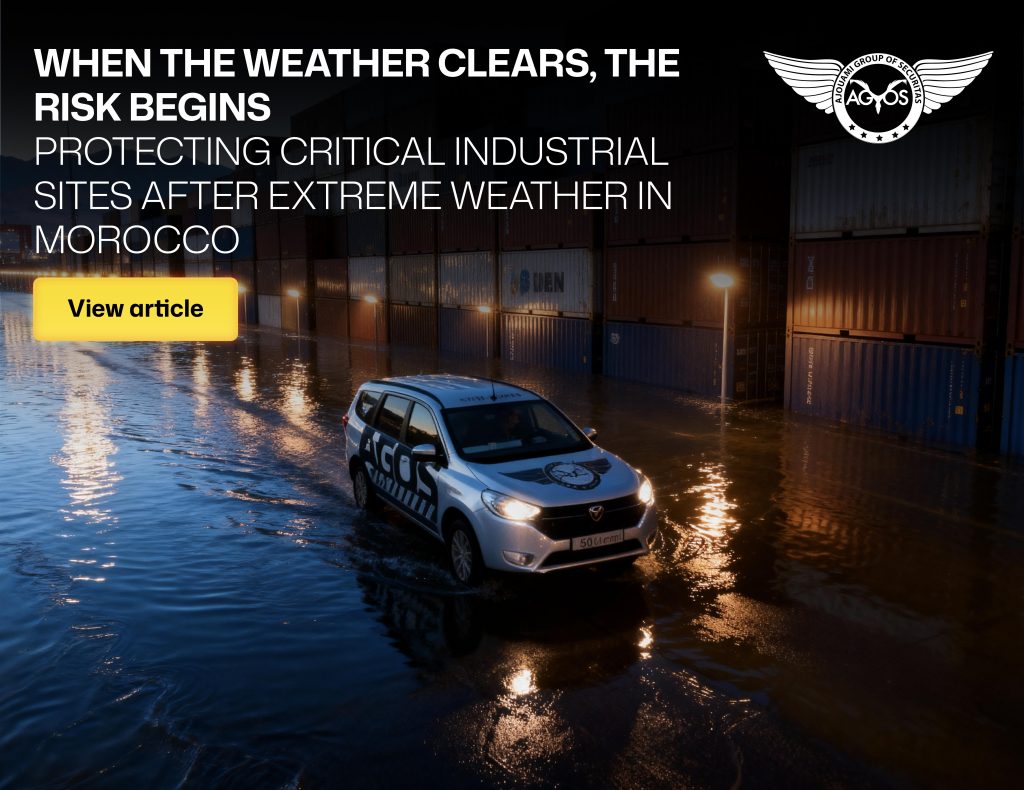
Protecting Critical Industrial Sites After Extreme Weather in Morocco
Over the past two weeks, Morocco has faced intense weather conditions, heavy rain, flooding, power disruptions, and limited access to industrial zones.
From a security standpoint, the most dangerous moment is not during the storm.
It’s right after.
When sites slow down or partially shut operations, vulnerabilities appear: fewer staff, damaged perimeters, poor visibility, and delayed response times. That combination creates the perfect window for theft, vandalism, and opportunistic intrusion.
At AGOS MOROCCO, we treat extreme weather as a predictable risk, not an exception.
During the past two weeks, our teams shifted into heightened posture:
- 24/7 monitoring and supervision
- Reinforced physical presence at exposed sites
- Adjusted patrol patterns and night coverage
- Immediate post-rain perimeter and access checks
Security in these conditions is not about reacting fast, it’s about being there before something happens.
The Lesson for Industrial Operators
Extreme weather events are becoming more frequent.
What separates resilient operations from exposed ones is what happens after the rain stops.
Security must stay visible, adaptive, and fully engaged especially when operations slow down.
Because your assets don’t pause when the weather does.
Sector-Specific Reality on the Ground
Automotive Plants
Production pauses don’t stop risk. Idle machinery, spare parts, and storage areas become prime targets if visibility drops or access control weakens. Continuous presence and perimeter discipline are essential.
Logistics Hubs & Warehouses
When trucks slow down, cargo doesn’t disappear—but attention often does. After storms, unsecured loading bays and reduced traffic create silent exposure, especially at night.
Ports
Weather disruption increases congestion, operational stress, and blind spots. The mix of high-value goods and complex access routes requires constant coordination and on-the-ground judgment.
Free Zones & Industrial Parks
Large footprints, multiple tenants, and uneven recovery timelines make post-weather security particularly challenging. One weak site can affect the entire zone.